

The French and Public Consultation – an interview with Laurence Monnoyer-Smith
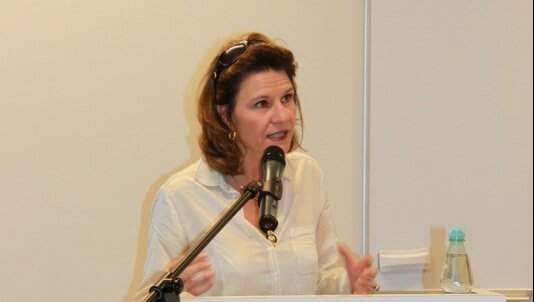
The interview was conducted by Anna Przybylska, working at the Center for Deliberation at the Institute of Sociology of the University of Warsaw, on July 25, 2013. The entire interview will be published in December 2013 in the next issue of “Res Publica Nowa”. We write more about the conference in a separate article .
Do you think that there is a need for legal regulations on when and how public consultations are conducted? What should and what should not be regulated?
This is a very interesting question. I think regulation is absolutely necessary. Otherwise things just don’t happen. Even in Western democracies, such as the United States and Great Britain, when consultations are not required, but the local government or government feels that they must organize them to legitimize the decision-making process, there is a risk of a lack of fairness of the process, with all the bad consequences.
In Poland, the local government has the power to prepare an act of local law regulating the principles of public consultation, and relevant resolutions have been adopted in some cities. Regulations vary in quality and authorities do not always comply with them, but attempts are being made to address this issue. Undoubtedly, we are dealing with a clash of regulatory concepts. At the moment, the Ministry of Administration and Digitization proposes a code of consultations instead of hard regulations.
Similarly, we started with a few regulations directly related to waste incineration plants, then we introduced public consultations preceding the construction of infrastructure, and in 1995 it was proposed to create an institution whose competence is public debate. The 1996 consultation charter presented the concept in its entirety, but its provisions were not binding. I know from experience that, firstly, regulations are necessary, and secondly, they can be introduced at different levels of public administration, depending on the country’s political culture. The national level is not necessarily the best. I think it really depends on how the administration is organized. For example, in Italy, regions have their own regulations, like Tuscany. This is also true in Germany. However, it should also be noted that too detailed regulations kill the debate. In principle, you only need to specify: the subject on which the consultation is carried out, the type and size of the project, its local and environmental impact, and such issues. Regulations should be soft, because the debate should always be adapted to the context, subject, people. We know up to 30 different types of consultation procedures, from few to many participants, from short-term to long-term. I am convinced that we need a law that leaves an independent institution free to act in accordance with the context and subject matter of the consultation. In France, public deliberations are conducted, which are within the competence of the KKDP, and smaller-scale consultations, which result, for example, from the preparation of a spatial plan. We have specific regulations that apply to chemicals produced by factories that carry out their own consultations. Then there are the consultations on climate change and biodiversity related to Agenda 21 (UN Conference, Rio), the specific consultations on incinerators and water resources – these are consultations that KKDP does not participate in. The law obliges to carry out consultations, e.g. on spatial development, but does not precisely define their organization. It depends on the local authority and may vary. And so we have consultations without meaning, as well as consultations with specific rules and procedures resulting from the local government’s commitment to public participation and the involvement of citizens. Above all, there is the KKDP, which tries to instill in local authorities special ways of thinking about public consultations and methods of conducting them. Part of my mission is to work on a culture of public consultation and public debate in France. This is because many local consultations are not conducted directly by us.
What does “good quality consultation” mean to you? What are the conditions for a good quality consultation process apart from regulations and institutionalization of procedures?
This is not an easy question because the literature on the quality of deliberation and consultation is vast. I have dealt with this issue a lot, which can be looked at from different perspectives. They can be captured from the side of the fairness of the process. This is a very important condition for good quality consultation. In good consultation, the decision maker is honest about how he wants to conduct it. Even if he is not sincere in his intentions, he can pretend that he is in order not to confront the residents, because this may jeopardize the project. So the “civilizing force of hypocrisy,” as Elster calls it, may play a role. Good quality consultation requires that the population affected by the project participates in it. Sometimes some stakeholders are missing. Why? Due to the fact that they are not informed that there is not enough time, and sometimes they find out about the consultations when they have already taken place and they did not participate in them. Pity. Good consultation is one where the flow of information helps stakeholders learn together; when experiences are exchanged, collective intelligence is built, and everyone develops their own knowledge of the project. They require peace and quiet, without an excess of aggressive communication. I’m not saying conflict is bad. Conflicts are related to differences of values and reasons, and it is important to put everything on the table. Hence, it may be necessary to go through the conflict phase. When all the arguments are “put on the table” there are no behind-the-scenes negotiations, and they happen extremely often. It is equally beneficial when consultations lead to local change, because authorities, associations, enterprises, the whole socio-institutional system have learned to cooperate. This is very good. Sometimes we have the impression that the consultations were of poor quality – not many arguments were put forward, people were not too interested in them because they had other matters to deal with, and two years later we realize that they did help this community mature and organize itself. Sometimes we realize that consultations have revealed something. It’s a long-term effect that’s hard to see. Sometimes we expect too much from a consultation. If we are considering a motorway or a high-speed rail route, this is a project that will be completed in 15 or 20 years. Consultation only takes a moment in a long process. There will be one debate, maybe another, a public inquiry, a design, and finally the start of construction. So we can’t expect everything from a consultation. We can expect small things. Another condition for successful consultations is that they take place when the project is not yet decided, when the door is open, when we can talk about the appropriateness of the project in relation to the details of its specifications. it lasts. There is also the question of how the quality of consultations is evaluated. There are different assessment dimensions. We cannot expect everything to be perfect. It’s a dream of an unreal world. Good consultation is when at least: the process is reliable, its effects are long-lasting, and people have learned more. At KKDP, we would like to work on an evaluation model that will help us return to old projects and determine how successful the consultations were. We have reports that record what was said – good and bad, sometimes leading to conflict; and after 5 years we can answer the question if it changed anything. However, I believe that the fundamental question remains whether the trial was based on sincerity.
What is the experience of online consultations in France? Are e-consultations treated as an alternative to the traditional way of collecting information, or a parallel method of collecting information in the same project?
I would say that e-participation developed about 10 years ago. Most online consultations and participatory processes are also organized offline. This is specific to France because, as I know, in the United States or in the United Kingdom, these are two separate areas. I know of a few experiments, but outside of these, most communication is online and offline , with more emphasis on face-to-face consultation, though a better combination of the two is now being developed. I’ve been doing this as a researcher, I’ve been involved in two case studies, and I think the combination of the two forms is very important. For me, this is a prerequisite for good consultation, because it allows for the inclusion of various participants.
And are the French willing to participate in public consultations? What does their participation depend on?
Willing to participate – I would not say. What I can say is that we have many non-governmental organizations and they are very willing to participate. It was the associations that proposed the creation of KKDP. They are responsible for the creation of the Commission because they loudly demanded it. I wouldn’t say that all people are willing to participate. But it’s more complicated. The issue of social inclusion is still a very important issue in the public debate. It would be a pity if the public debate turned into a council of non-governmental organizations. We still want the presence of citizens. This is more difficult to achieve. The involvement of associations is related to the fact that this is partly the purpose of their existence. On the other hand, a positive consequence of consultations is that they help to create associations, because people become aware of certain issues, they organize themselves to join the public debate. I’m not sure if I’m right, but I would say that people in France like to be able to participate in public affairs, but they don’t necessarily participate in them. This is a common comment from municipal officials who say: “People declare that they want to participate, we organize a meeting, and nobody comes.” Why? There is no simple answer because the matter is complex. There are several factors that make up the context. When the subject of the debate is important – people come – en masse. That’s the kind of answer I can give.
What are the main criticisms of the use of public consultations? Is this a factual critique? If so, what are the facts?
One of the main criticisms is the high cost, another is the long consultation time. Public consultations take time, and sometimes politicians elected to public office want their project to be implemented quickly. They are elected for 5 years, so that’s understandable. But at the same time, it’s a miscalculation, because if they skip consultation, they usually end up in trouble or make serious mistakes with long-term consequences. Some government officials go through the design process only to conclude that people disagree with the work they have done; and they feel really bad because the citizens don’t agree with the person they elected. People may disagree. This is a problem of democracy. There are also criticisms of the methodology, but this is very specific, taken up in specific debates.